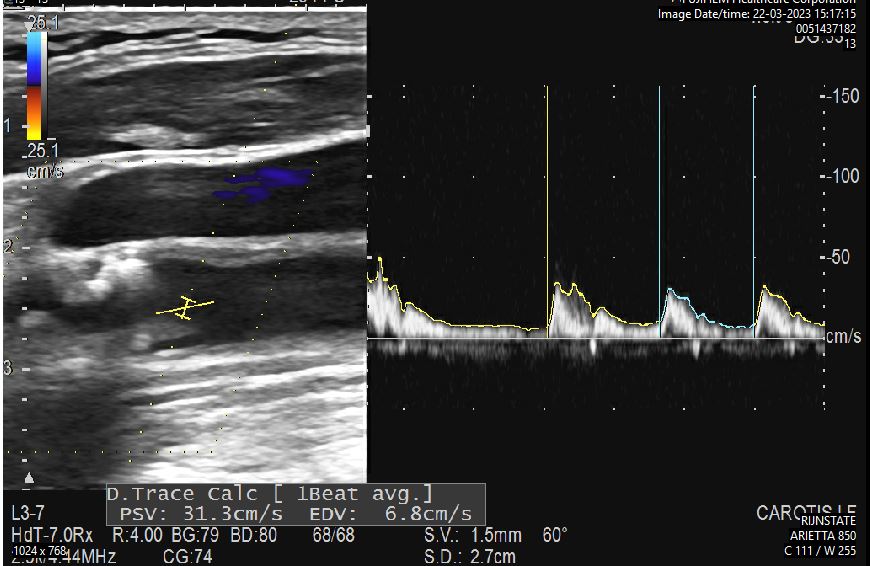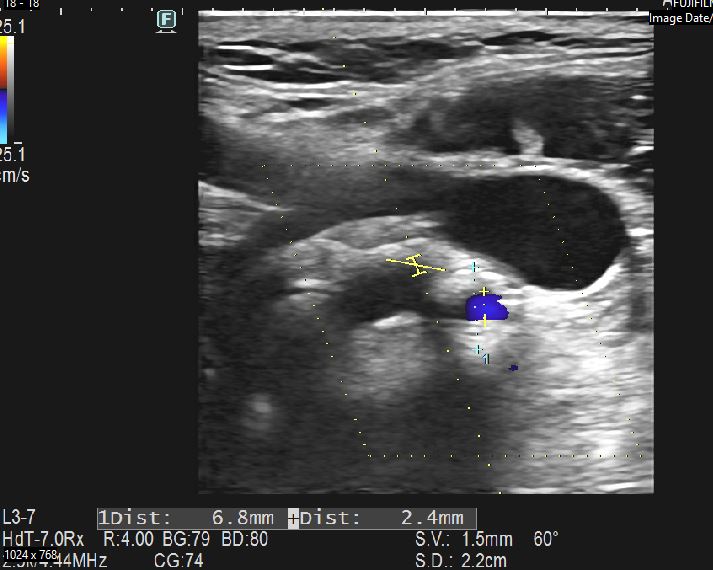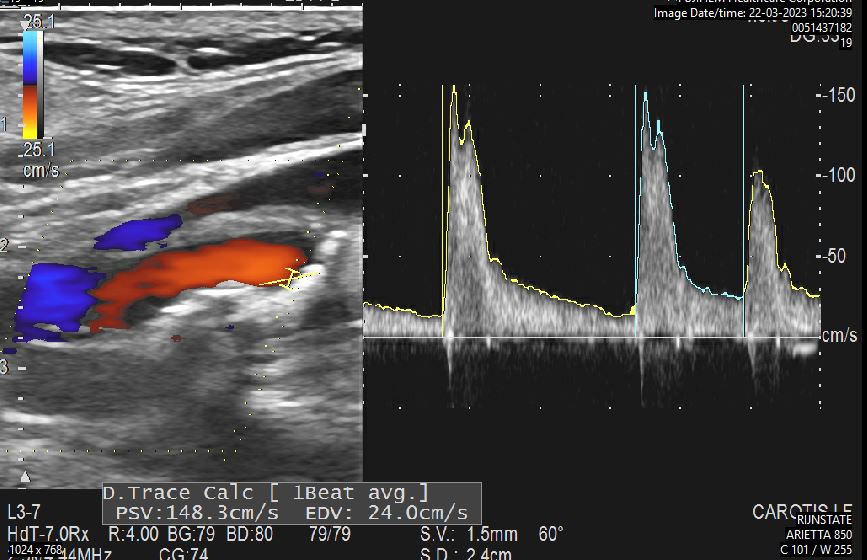

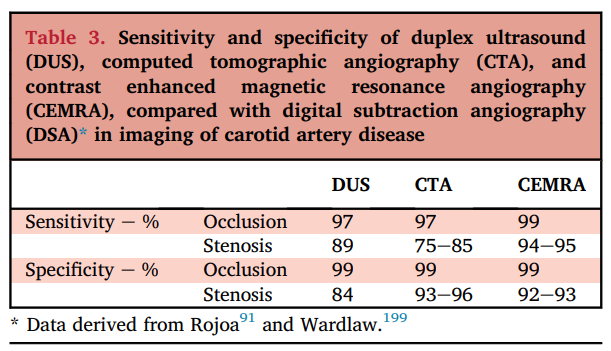
When you suspect a carotid artery stenosis, duplex ultrasound is a good screening tool. The sensitivity for carotid artery stenosis is 89% and the specificity is 84%.
There are two options in calculating the degree of stenosis of the internal carotid artery: according to the NASCET and to the ECST criteria, where the NASCET is the most widely used one. NASCET compares the diameter of the distal healthy internal carotid artery to the smallest lumen diameter, while the ECST compares the smallest lumen diameter to the diameter of the internal carotid artery in the same place. The ESVS guidelines adhere to the NASCET criteria because of greater reliability, however when there is a voluminous plaque in the carotid bulb, this method might not be accurate and it might be preferred to use the ECST criteria in this case.

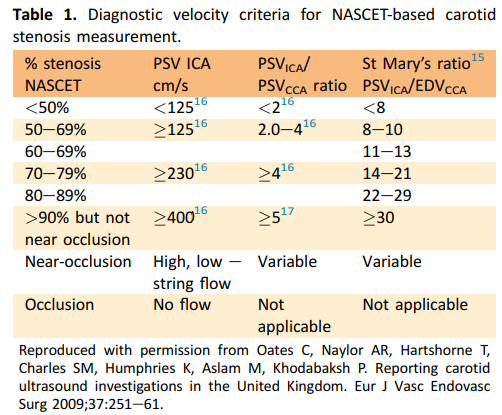
When measuring carotid artery stenosis, the degree of stenosis is not only based on the diameters. The benefit of duplex ultrasound is that blood flow velocities can be measured, in addition to the two dimensional image. The absolute peak systolic velocity in the internal carotid artery, and the peak systolic velocity ratio of the internal and common carotid arteries are used. The 2018 guidelines propose a table that can be used as reference for these velocities, but it is important that every vascular laboratory validates their own cut off points.
An example of duplex ultrasound of the carotid artery can be seen in the video below.
For more detailed information on duplex ultrasound on the carotid artery, the full video of the carotid duplex can be seen in the link below.
”It
Click to view all 3 images